How Slot Machines Decide When You Win: A Beginner’s Guide to Game Mechanics
You press spin. The reels blur. They stop. You either win or you don’t.
But what actually happens in that split second? What decides the outcome?
Most players never ask. They just spin, watch, and hope. But once you understand the mechanics behind a slot machine, the whole game starts to make more sense. You stop chasing patterns that don’t exist. You stop believing myths that cost you money.
This guide breaks it down simply. No jargon. No fluff. Just how slot machines actually work, from the inside out.
If you want a deeper look at the numbers behind the game check out what online slots are and how RTP works.
The Short Answer First
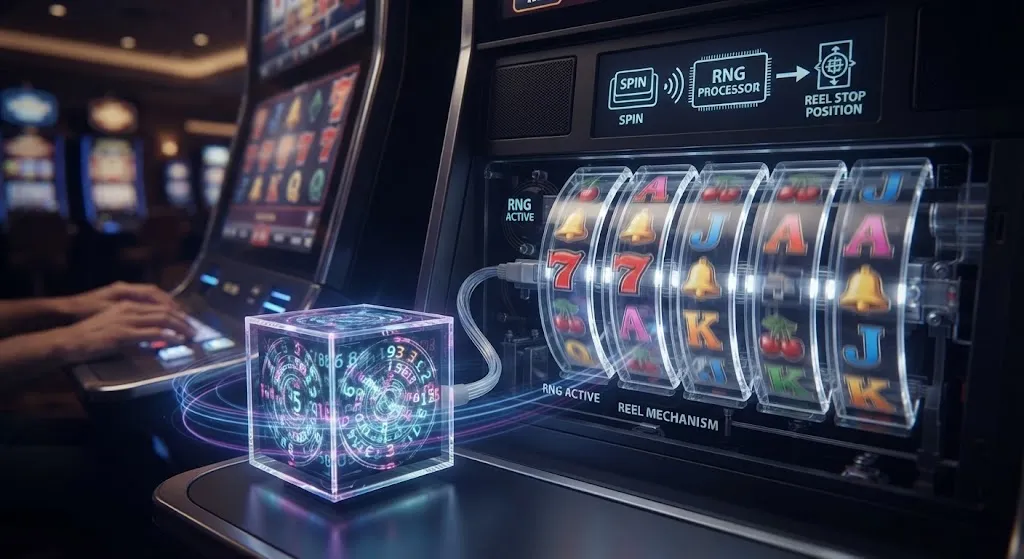
Every spin on a modern slot machine is decided by a computer program called a Random Number Generator, or RNG.
The RNG picks a random number the moment you hit spin. That number maps to a result. The reels just show you that result visually.
There’s no pattern. No cycle. No machine “getting ready” to pay out. Each spin stands completely alone.
That’s the core idea. Everything else in this guide just explains how we get there.
What Is a Random Number Generator?
Think of the RNG as the brain of the slot machine.
It’s a small piece of software running constantly, even when nobody is playing. It continuously generates random values, often at a very high rate, even when the game isn’t being actively played.
The moment you click spin, the RNG grabs whatever number it landed on at that exact instant. That number gets translated into a result. Which symbols land where. Whether you win or lose. How much you win, if you do.
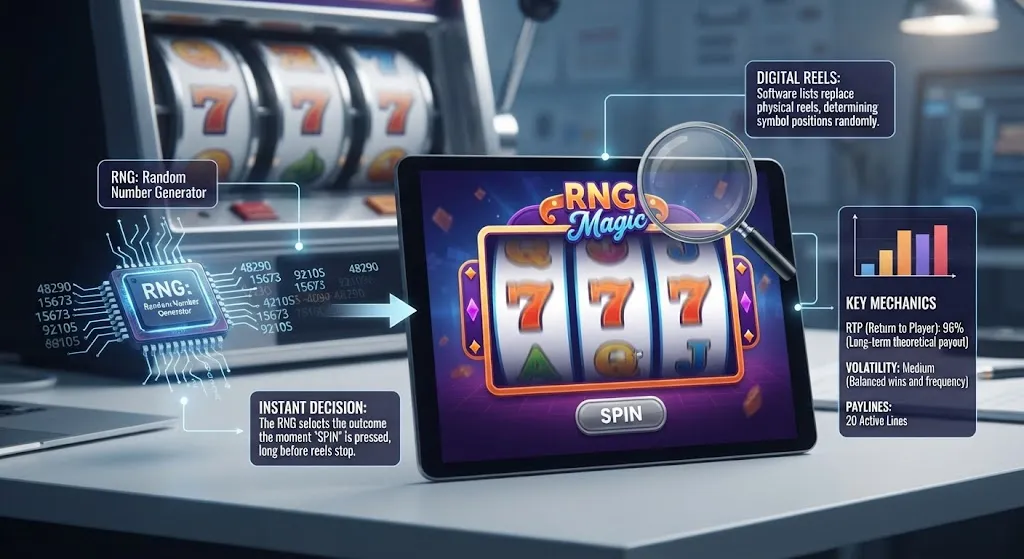
This all happens in milliseconds. Long before the reels finish spinning on your screen, the outcome is already locked in. The spinning animation is just for show. It’s built to feel exciting, but it doesn’t affect anything.
That’s an important point, so it’s worth repeating. The visual spin does not determine the result. The RNG already decided before the reels even start moving.
Why This Matters for Players
Once you understand the RNG, a few common beliefs fall apart.
Myth: A machine is “due” for a win. Not true. Every spin is independent. The machine has no memory of your last ten spins, or your last thousand. Past results never affect future ones.
Myth: Playing at a certain time of day changes your odds. Also not true. The RNG doesn’t care what time it is. It runs the same way at 3pm and 3am.
Myth: A “hot” machine will keep paying out. There’s no such thing as a hot or cold machine in the way players imagine. Wins and losses are random, not connected in a chain.
None of these myths are your fault. Slot machines are designed to feel like they have rhythm and momentum. That’s part of the entertainment. But underneath the lights and sounds, it’s pure math.
How Reels and Symbols Actually Work
Old mechanical slot machines used physical reels with a limited number of symbols on each one. What you saw was what existed.
Modern online slots don’t work that way. There are no physical reels at all. Everything is digital.
Behind the scenes, each reel is really a long list of possible symbols and blank spaces, stored in the software. The RNG generates a random outcome that the game’s software maps to specific reel positions and symbols. The game then displays whatever symbols land in that position.
This is why modern slots can have wild bonus features, huge jackpots, and symbols that seem to appear more or less often than others. The developer designs the list. The RNG just picks positions from it, at random.
What Are Paylines?
A payline is simply a pattern across the reels that can produce a win.
The classic version is a straight line across the middle row. Land three matching symbols in a row, and you win.
Modern slots often use dozens, or even hundreds, of paylines. Some go diagonal. Some zigzag. Some games skip paylines entirely and use a “ways to win” system instead, where matching symbols anywhere on adjacent reels count as a win.
More paylines usually means more small wins, but it doesn’t change the underlying math of the game. The RTP and house edge stay based on the overall design, not the number of paylines alone.
Where RTP Fits Into All This
You’ll often see a percentage listed next to a slot game, something like 96%. That’s the RTP, or Return to Player.
RTP is a long-term average. It tells you how much of all the money wagered on a game is expected to be paid back to players over a very large number of spins. Not your spins specifically. Millions of them, combined, across every player.
A 96% RTP doesn’t mean you’ll get $96 back for every $100 you spend today. It means that, mathematically, over a massive sample size, the game returns 96% of everything wagered on it.
Your actual session could go either way. You could lose your whole budget in ten minutes. You could hit a jackpot on your second spin. RTP describes the game’s design, not your personal luck on any given day.
We go deeper into how RTP is calculated and why it matters in our full guide to online slots, if you want the complete breakdown.
What Is Volatility?
RTP tells you how much comes back over time. Volatility tells you how it comes back.
Low volatility slots pay out small wins fairly often. Your balance moves in small steps, up and down, without huge swings.
High volatility slots pay out less often, but when they hit, the wins can be much bigger. Your balance can sit flat for a while, then jump suddenly.
Neither is better than the other. It depends on what kind of experience you want. Low volatility suits players who want longer sessions with steady, small results. High volatility suits players chasing bigger swings and are comfortable with longer dry spells between wins.
Why Near Misses Feel So Common
You’ve probably seen it. Two matching symbols land, and the third just barely misses, one position off.
It feels like you almost won. Your brain treats it like a close call, the same way a near-miss free throw feels close in basketball.
But mathematically, a near miss is no different from any other loss. The RNG picked a losing result. The reels just happened to display it in a way that looks close.
Some games are designed with this visual effect intentionally, because it keeps players engaged. It’s not cheating, and it doesn’t affect the odds. But it’s worth knowing it’s happening, so it doesn’t trick you into thinking you’re “close” to a pattern that isn’t there.
Are Online Slots Fair?
Legitimate online slots are tested and certified by independent third parties. These testing labs check the RNG for true randomness and confirm the game pays out at the advertised RTP over time.
Licensed casinos are required to use certified game providers. This is one of the biggest reasons to stick with regulated, licensed platforms rather than obscure or unlicensed sites. Certification doesn’t guarantee you’ll win. It just confirms the game is mathematically fair and not secretly rigged against players.
The Simple Version, One More Time
Here’s the whole guide in a few lines.
The RNG picks a random result the instant you spin. The reels just display that result. Nothing about timing, streaks, or “due” machines changes the odds. RTP tells you the long-term average payback. Volatility tells you how that payback is distributed, in small frequent wins or bigger rare ones. Near misses feel meaningful, but they aren’t. And fairness comes down to independent testing, not luck or superstition.
Once you understand this, slots become a lot less mysterious. You’re not decoding a hidden pattern. You’re just playing a game built on random chance, with math running quietly underneath every spin.
If you want to go further into the numbers, including a full breakdown of RTP and how it’s calculated, check out the complete guide: What Are Online Slots?
Frequently Asked Questions About Slot Machines
How does a slot machine decide if you win?
A slot machine uses a Random Number Generator (RNG) to determine the outcome of each spin. The selected result is then displayed through the game’s reels and symbols.
Does the RNG decide the result before the reels stop?
Yes. In modern slot games, the RNG determines the outcome when the spin is initiated. The reel animation then displays that result.
Can previous spins affect the next spin?
No. Each spin is an independent event. Previous wins or losses don’t make a future spin more or less likely to win.
Does stopping the reels early change the result?
No. Stopping or speeding up the visual reel animation does not change the outcome already determined by the RNG.
What does 96% RTP mean on a slot?
A 96% RTP means the game is mathematically designed to return about 96% of the amount wagered over a sufficiently large number of plays. It does not mean an individual player receives 96% back during a particular session.
Does a high RTP guarantee that I will win?
No. RTP is a long-term statistical measure, not a guarantee of profit on an individual session or spin.
Sources
- UK Gambling Commission – RTS 7: Generation of Random Outcomes — official regulatory standard requiring RNG outputs to be “acceptably random” and banning adaptive or compensated game behavior.
- UK Gambling Commission – Remote Gambling and Software Technical Standards — full technical standards document covering RTP disclosure, result determination, and testing requirements.
- iTech Labs – RNG Testing and Compliance — independent testing lab explaining how RNGs and RTP are evaluated and certified for online casino games.
- Gaming Laboratories International (GLI) — one of the largest independent testing and certification bodies for gaming equipment and software worldwide.
- eCOGRA – Testing, Inspection and Certification — testing organization covering RNG integrity, RTP accuracy, and operator conduct standards.