How Big Was Nigersaurus? Size, Weight and Comparison to Other Sauropods
Nigersaurus was approximately 9 meters (30 feet) long and weighed around 4 metric tonnes (4.4 short tons), making it relatively small compared with many other long-necked dinosaurs. Despite its modest size, this unusual plant-eater was famous for its wide mouth, lightweight skull and hundreds of replacement teeth.
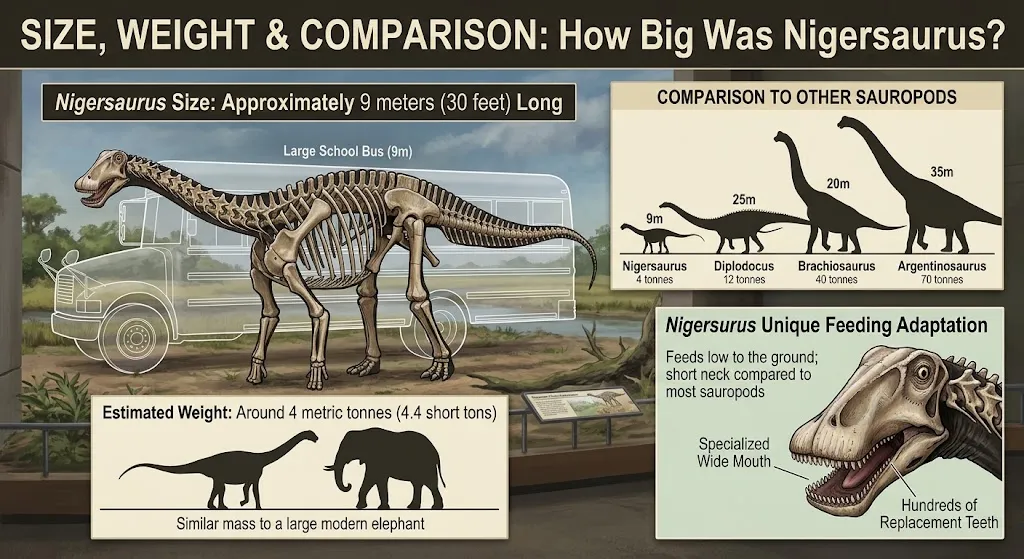
Living around 110 million years ago in what is now Niger, Africa, Nigersaurus was a remarkable example of how diverse sauropods could be. It was much smaller than enormous dinosaurs such as Diplodocus and Argentinosaurus, but its distinctive body shape and feeding adaptations made it equally fascinating.
Nigersaurus Size at a Glance
Nigersaurus was a medium-sized dinosaur by ordinary standards but relatively small for a sauropod. Its estimated measurements provide a useful picture of its overall proportions.
| Feature | Estimated measurement |
|---|---|
| Length | About 9 meters (30 feet) |
| Weight | Around 4 metric tonnes (8,800 pounds) |
| Shoulder height | Approximately 2–3 meters (6.5–10 feet) |
| Neck | Relatively short for a sauropod |
| Skull | Approximately 30 centimeters (12 inches) long |
| Period | Early Cretaceous, about 110 million years ago |
These measurements are estimates rather than exact figures. Fossil remains do not preserve every part of the animal, so paleontologists reconstruct its size using available bones and comparisons with related dinosaurs.
Nigersaurus belonged to the rebbachisaurid group of sauropods, a family known for relatively lightweight skeletons and specialized feeding adaptations.
How Long Was Nigersaurus?
Nigersaurus was about 9 meters long from its head to the tip of its tail. That is roughly shorter than a large school bus, although its body shape was very different.
Its long tail and relatively short neck contributed to its overall length. Unlike some of the most famous sauropods, which had extremely elongated necks, Nigersaurus had a more compact body plan.
The dinosaur’s length is reconstructed from fossil material discovered in the Elrhaz Formation of Niger. Although important parts of its skeleton have been recovered, the fossil record is not complete.
Paleontologists use measurements of preserved bones, the proportions of related rebbachisaurids and anatomical reconstructions to estimate the animal’s total length. This is why different sources sometimes report slightly different figures.
The commonly cited estimate of approximately 9 meters remains a useful general measurement for understanding the size of Nigersaurus.
How Much Did Nigersaurus Weigh?
Nigersaurus is commonly estimated to have weighed around 4 metric tonnes, although some reconstructions suggest a lighter animal.
That would make it much lighter than the enormous sauropods that weighed several tens of tonnes. However, a four-tonne dinosaur was still a substantial land animal.
Scientists estimate dinosaur weight by reconstructing the animal’s body volume from its skeleton and then calculating the likely mass of its muscles, organs and other tissues.
Different reconstruction methods can produce different results, especially when the skeleton is incomplete.
One particularly interesting feature of Nigersaurus was its lightweight skeletal structure. Its vertebrae contained extensive air spaces, a characteristic known as pneumaticity.
These air-filled spaces reduced the weight of its skeleton without necessarily making the bones weak. Similar adaptations occurred in other sauropods and are also found in modern birds.
Nigersaurus therefore combined a relatively large body with a skeleton that helped keep its overall weight manageable.
How Tall Was Nigersaurus?
Nigersaurus was relatively low to the ground compared with many other sauropods. Its short neck and feeding adaptations allowed it to reach vegetation close to the ground without needing to stretch upward like some of its relatives.
Its estimated shoulder height is less certain than its overall length. The exact height would depend on the reconstruction and the posture of the animal.
Unlike Brachiosaurus, which had long forelimbs that raised its shoulders, Nigersaurus had a body plan better suited to feeding on low-growing plants.
Its head was positioned near the ground, and its neck was relatively short for a sauropod. These features helped it feed efficiently on vegetation without needing to reach high into trees.
Nigersaurus Compared to Other Sauropods
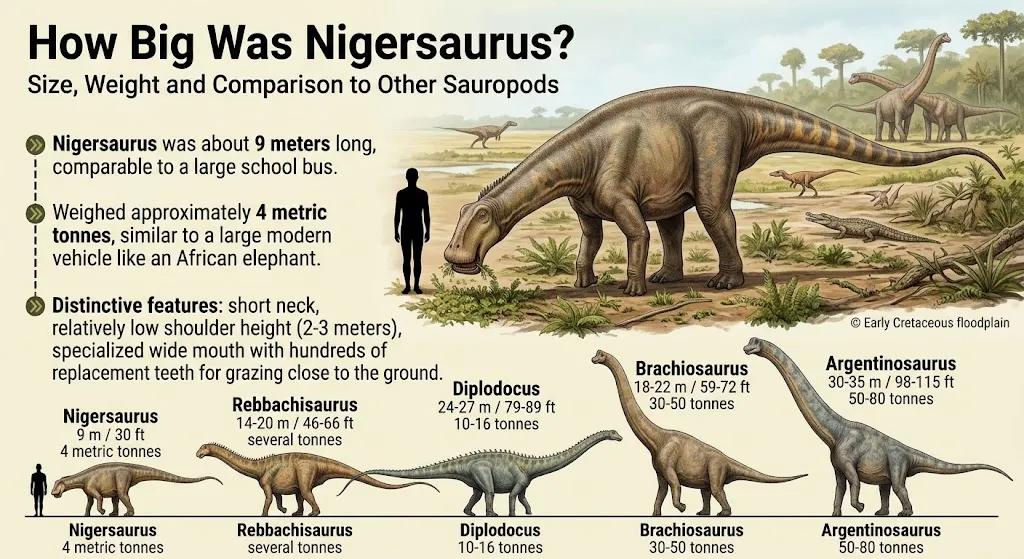
Nigersaurus was much smaller than some of the best-known sauropods. Comparing its estimated size with other dinosaurs makes its place among these long-necked giants easier to understand.
The following figures are approximate. Dinosaur size estimates vary between scientific reconstructions, especially for species known from incomplete skeletons.
| Sauropod | Estimated length | Estimated weight |
|---|---|---|
| Nigersaurus | 9 m (30 ft) | 4 tonnes |
| Rebbachisaurus | 14–20 m (46–66 ft) | not well established |
| Diplodocus | 24–27 m (79–89 ft) | 10–16 tonnes |
| Brachiosaurus | 18–22 m (59–72 ft) | 30–50 tonnes |
| Argentinosaurus | 30–35 m (98–115 ft) | 50–80 tonnes |
These comparisons show that Nigersaurus was considerably smaller than many famous sauropods. It was not the enormous, towering animal that people often imagine when they think of long-necked dinosaurs.
Nigersaurus vs. Diplodocus
Diplodocus was approximately three times as long as Nigersaurus. Its extremely elongated neck and tail gave it a very different appearance, even though both dinosaurs belonged to the broader sauropod group.
Diplodocus also had a much longer neck, allowing it to reach vegetation across a wider area. Nigersaurus, in contrast, had a more compact neck and specialized mouth suited to feeding close to the ground.
Nigersaurus vs. Brachiosaurus
Brachiosaurus was substantially heavier than Nigersaurus and had a very different body shape. Its long forelimbs raised its shoulders, allowing it to reach higher vegetation.
Nigersaurus was built for a lower browsing position. Its comparatively small size and low head posture made it better suited to feeding on plants near the ground.
Nigersaurus vs. Argentinosaurus
Argentinosaurus was one of the largest known sauropods, with estimated lengths of around 30 meters or more.
Compared with this giant, Nigersaurus was remarkably small. Argentinosaurus may have weighed more than ten times as much, depending on the estimates used.
The comparison highlights the enormous range of body sizes that evolved among sauropods.
Nigersaurus Compared to Familiar Things
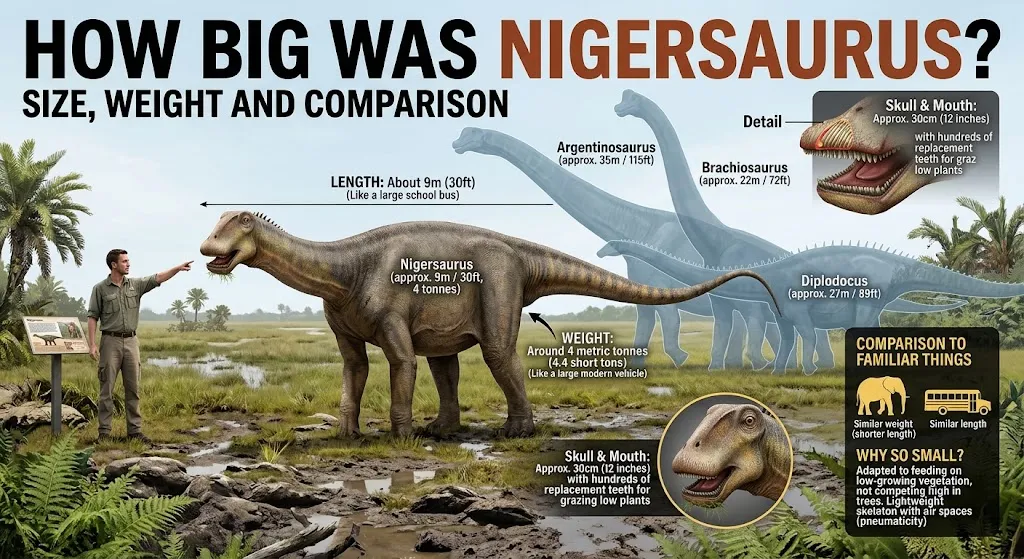
Dinosaur measurements can be difficult to imagine. Comparing Nigersaurus with familiar modern objects and animals gives a clearer sense of its size.
Nigersaurus vs. an African elephant
An adult African elephant can weigh around 4–7 tonnes. Nigersaurus was therefore in a similar weight range, although it was much longer and had a completely different body shape.
Nigersaurus vs. a school bus
At approximately 9 meters long, Nigersaurus was roughly comparable in length to a large school bus. Its long tail contributed significantly to that measurement.
Nigersaurus vs. a human
A 1.7-meter-tall adult would be much shorter than Nigersaurus’s overall length. Even though Nigersaurus was small for a sauropod, it would still have been an imposing animal beside a person.
The elephant comparison is particularly useful because it shows that Nigersaurus was not a tiny dinosaur. It was simply much smaller than the largest members of its own group.
Why Was Nigersaurus So Small?
Scientists cannot identify a single reason why Nigersaurus was smaller than many other sauropods. Its size was probably related to a combination of evolutionary adaptations, feeding habits and the environment in which it lived.
Nigersaurus lived in a landscape of floodplains and river systems in what is now Niger. The region supported a diverse range of plants and animals during the Early Cretaceous.
Its specialized mouth and teeth indicate that it was adapted to feeding on relatively low-growing vegetation.
Rather than competing directly with large sauropods for food high in trees, Nigersaurus could exploit a different feeding niche. This may have helped it thrive despite its smaller body size.
Its lightweight skeleton also suggests that it was adapted to a different body plan from the heaviest sauropods.
For more information about its unusual feeding adaptations, read What Did Nigersaurus Eat?.
Its distinctive mouth is also explored in Nigersaurus: Dinosaur That Has 500 Teeth.
Was Nigersaurus Full-Grown?
Nigersaurus is generally described as a relatively small sauropod, but determining the exact size of a fully grown individual is difficult.
Paleontologists can examine bone growth patterns to estimate the age and maturity of fossil animals. However, the available fossil evidence does not establish one definitive adult size for every individual.
The approximately 9-meter length commonly reported for Nigersaurus should therefore be understood as an estimate of its overall size, not a precise measurement of the maximum possible length of the species.
Frequently Asked Questions
Nigersaurus was approximately 9 meters long, making it about five times the length of a 1.7 m adult. It was also much heavier, with an estimated mass of around 4 tonnes.
Nigersaurus was relatively small for a sauropod, but it was not necessarily the smallest. Other sauropods, including some smaller-bodied species, were shorter or lighter. Nigersaurus is better described as a small sauropod rather than the smallest sauropod ever discovered.
Nigersaurus is commonly estimated to have weighed around 4 metric tonnes. Some reconstructions suggest a lower weight, so this figure should be treated as an approximate estimate.
Nigersaurus was longer than an African elephant, but its estimated weight was similar to that of a large elephant. Its body was much longer and lower to the ground than an elephant’s.
The skull of Nigersaurus was relatively small and lightweight, measuring approximately 30 centimeters in length in commonly cited reconstructions. Its wide mouth and distinctive tooth arrangement made it unusual among sauropods.
Conclusion
Nigersaurus was approximately 9 meters long and weighed around 4 tonnes, making it a relatively small sauropod compared with giants such as Diplodocus, Brachiosaurus and Argentinosaurus.
Its short neck, lightweight skeleton and specialized mouth reveal a dinosaur adapted to feeding close to the ground rather than reaching high into trees.
Although it was not one of the largest dinosaurs, Nigersaurus remains one of the most distinctive sauropods ever discovered. Its unusual body proportions show that sauropods evolved a remarkable variety of sizes and feeding strategies.
Editorial note: The length, weight, height and skull measurements in this article are approximate. Verify the comparative figures against the original scientific literature before publication, as estimates vary between reconstructions.
Sources and Further Reading
- Sereno, P.C., Wilson, J.A., Witmer, L.M., Whitlock, J.A., Maga, A., Ide, O., & Rowe, T.A. (2007). Structural Extremes in a Cretaceous Dinosaur. PLoS ONE, 2(11), e1230. https://doi.org/10.1371/journal.pone.0001230
- Sereno, P.C., Beck, A.L., Dutheil, D.B., Larsson, H.C.E., Lyon, G.H., Moussa, B., Sadleir, R.W., Sidor, C.A., Varricchio, D.J., Wilson, G.P., & Wilson, J.A. (1999). Cretaceous Sauropods from the Sahara and the Uneven Rate of Skeletal Evolution Among Dinosaurs. Science, 286(5443), 1342–1347. https://doi.org/10.1126/science.286.5443.1342
- Public Library of Science (2007). Dinosaur From Sahara Ate Like a “Mesozoic Cow.” ScienceDaily. https://www.sciencedaily.com/releases/2007/11/071115113252.htm