What Did Nigersaurus Eat? The Diet of a Cretaceous Grazer
Nigersaurus ate low-growing plants such as ferns and horsetails. It cropped them with a wide, straight-edged muzzle lined with about 500 teeth, including replacements. This small Cretaceous sauropod lived roughly 115 to 105 million years ago in what is now Niger, and its skull was built for feeding close to the ground.
This article explains what Nigersaurus ate, how it fed, and how scientists know. For a general overview, see our guide to Nigersaurus.
Key facts
- Diet: Herbivore (ferns, horsetails, other low-growing plants)
- Teeth: About 500, including replacement teeth
- Tooth replacement: Roughly every 14 days
- Lived: About 115 to 105 million years ago
- Where: Elrhaz Formation, Niger
- Group: Rebbachisaurid sauropod
What Was Nigersaurus’s Diet?
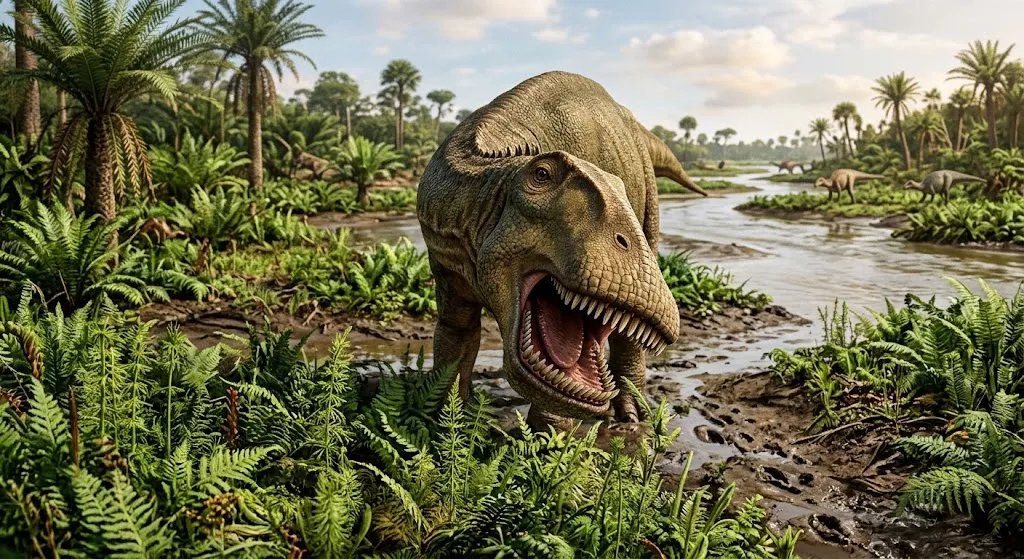
Nigersaurus was a herbivore, meaning it ate plants rather than other animals. Its diet probably consisted primarily of soft, low-growing vegetation available across the ancient floodplains of what is now the Sahara Desert.
Likely food sources included:
- Ferns and other low-growing plants
- Horsetails, which commonly grew in wet environments
- Young shoots and leaves from small plants
- Other soft vegetation growing close to the ground
Although scientists cannot identify every plant Nigersaurus ate, its skull and tooth wear patterns are consistent with a specialized low-level feeder.
During the Cretaceous Period, the region where Nigersaurus lived was much wetter than the modern Sahara. Rivers, floodplains, and seasonal wetlands supported diverse plant communities, providing a plentiful food supply for herbivorous dinosaurs.
How Did Nigersaurus Eat?
Nigersaurus had one of the most unusual feeding adaptations among sauropod dinosaurs.
Its broad, straight-edged muzzle resembled a natural lawn mower. The front of its mouth contained numerous closely packed teeth arranged in rows, allowing it to crop vegetation efficiently.
Instead of using a narrow snout to select individual leaves, Nigersaurus could sweep its mouth across patches of low vegetation and gather large quantities of plant material.
Its skull was extremely lightweight, with bone paper-thin in places and large openings. Studies of its inner ear suggest it held its head pointed sharply downward, with the muzzle close to the ground.
Hundreds of Teeth for Efficient Grazing
One of the most remarkable features of Nigersaurus was its dental arrangement. Its jaws contained about 500 teeth when replacement teeth are included. These teeth were slender and arranged in tightly packed rows, forming a dental battery, with enamel mainly on the outer face.
New teeth developed behind existing ones and moved into position as older teeth wore down or were lost. Each tooth was replaced roughly every two weeks, which is one of the fastest replacement rates known in a dinosaur. This constant replacement suited an animal that repeatedly cropped tough, abrasive plants.
Nigersaurus was not adapted for chewing in the same way as mammals. Like many other sauropods, it likely swallowed much of its food with limited oral processing.
Why Did Nigersaurus Have Such a Wide Mouth?
Nigersaurus had a broad, squared-off muzzle that was much wider than the rest of its skull, giving it a distinctive appearance.
This unusual shape was closely associated with its feeding strategy.
A wide mouth allowed the dinosaur to collect vegetation across a larger area with each feeding movement. Combined with its closely packed teeth, this adaptation made it particularly effective at cropping low-growing plants.
Its downward-facing mouth also suggests that it frequently fed near the ground rather than reaching high into trees.
These characteristics distinguish Nigersaurus from many other sauropods, which had narrower skulls and feeding adaptations suited to different types of vegetation.
Did Nigersaurus Eat Grass?
Grasses were not yet widespread during the time Nigersaurus lived, and there is no evidence that grass was part of its diet. Instead, Nigersaurus most likely fed on ferns, horsetails and other soft, low-growing plants.
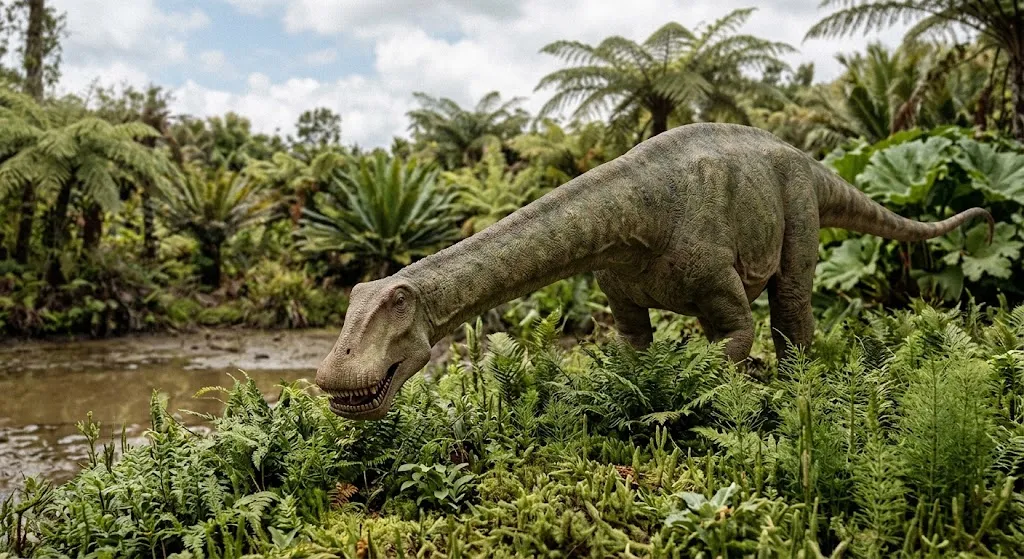
Its feeding adaptations were well suited to cropping low plants, but they do not demonstrate that it ate modern-style grass.
The term “Cretaceous grazer” is therefore useful for describing its feeding behavior, even though its diet was probably quite different from that of modern grazing mammals.
Where Did Nigersaurus Find Its Food?
Nigersaurus lived in the region of present-day Niger in Africa, particularly in the ancient environments represented by the Elrhaz Formation.
During the Cretaceous Period, this region supported extensive river systems and floodplains. These environments provided water and supported a variety of plants.
The landscape was home to numerous other dinosaurs, including large predators and herbivores.
Nigersaurus probably fed on vegetation growing along riverbanks and across floodplain environments, where soft plants were readily available.
Its relatively short neck and downward-oriented feeding posture would have allowed it to forage efficiently across these habitats.
How Do Scientists Know What Nigersaurus Ate?
Scientists rely on several lines of evidence:
- Skull and muzzle shape: The wide, square muzzle is built for cropping low vegetation in bulk.
- Inner ear anatomy: CT scans suggest the head was habitually held pointing downward.
- Tooth wear: Microscopic wear patterns on the teeth (studied by Whitlock, 2011) are consistent with feeding at or near ground level.
- Tooth replacement: Rapid replacement fits an animal eating tough, abrasive plants.
- Habitat evidence: Fossils from the Elrhaz Formation show a river and floodplain environment that supported plenty of low-growing plants.
Although these findings provide a strong picture of its feeding behavior, the precise proportions of different plants in its diet remain uncertain.
Nigersaurus Compared With Other Plant-Eating Dinosaurs
Nigersaurus belonged to a group of sauropods called rebbachisaurids. Its specialized feeding adaptations made it different from many other long-necked dinosaurs.
For example, some sauropods had longer necks and were better suited to reaching vegetation at different heights.
Nigersaurus, by contrast, appears to have been particularly adapted to feeding close to the ground.
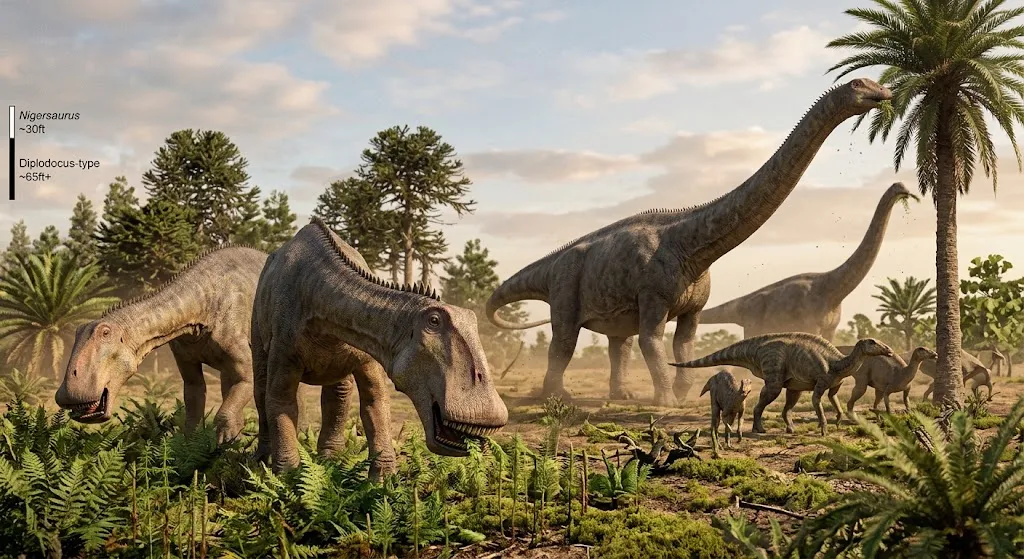
This difference illustrates how herbivorous dinosaurs evolved a variety of feeding strategies to take advantage of different food sources.
By specializing in low-growing vegetation, Nigersaurus may have occupied a distinct ecological niche within its ancient ecosystem.
Conclusion
Nigersaurus was a remarkable example of how dinosaurs evolved specialized ways of obtaining food.
Its broad muzzle, hundreds of continuously replaced teeth, and ground-level feeding adaptations made it particularly effective at cropping low-growing vegetation.
Although its exact diet remains uncertain, the available evidence suggests that this Cretaceous sauropod was a specialized herbivore that fed on soft plants across the ancient floodplains of Africa.
Its unusual anatomy continues to provide valuable insights into the diversity of feeding strategies among long-necked dinosaurs.
To learn more about this dinosaur, read our full guide to Nigersaurus.
Frequently Asked Questions
Nigersaurus mainly ate soft, low-growing plants, including ferns, horsetails, and young vegetation.
It had about 500 teeth, including replacement teeth that continuously developed throughout its life.
Its unusually wide muzzle and closely packed teeth helped it crop large amounts of vegetation close to the ground.
There is no evidence that grass was part of its diet. It probably ate ferns, horsetails and other soft plants.
It lived approximately 115–105 million years ago during the Cretaceous Period.
Probably very little. Its teeth were built for cropping, and it likely swallowed plant material with limited processing.
Sources
- Sereno, P. C., et al. (2007). Structural Extremes in a Cretaceous Dinosaur. PLoS ONE.
- Sereno, P. C., et al. (1999). Cretaceous Sauropods from the Sahara and the Uneven Rate of Skeletal Evolution among Dinosaurs. Science.
- Whitlock, J. A. (2011). Inferences of Diplodocoid (Sauropoda: Dinosauria) Feeding Behavior from Snout Shape and Microwear Analyses. PLoS ONE.